


Beyond Four Letters: The Cornerstone Principles That Power Everything DiSC®

Blog post updated 26th October 2026
Most personality frameworks are treated like name badges: you take a test, get assigned a category, and use it as an explanation for why you work and behave the way you do.
Everything DiSC® approaches human interaction differently. Rather than boxing people into static categories, the model functions as a behavioral compass designed to increase self-awareness and social agility. Grounding this framework are core foundational principles which are referred to as the Cornerstone Principles.
Understanding these principles transforms DiSC from a simple icebreaker assessment into a practical, long-term tool for organisational culture and team performance.
1. All DiSC Styles Are Equally Valuable
In workplace cultures, certain personality traits are often subtly favoured over others. Fast-paced, assertive profiles (D and i) are frequently celebrated as "natural leaders," while methodical, consensus-driven profiles (S and C) might be viewed merely as support functions.
Everything DiSC rejects this hierarchy:
No style is superior to another. High performance requires the direct drive of the D style, the enthusiasm and network-building of the i style, the reliability and support of the S style, and the analytical rigour of the C style.
Organisations thrive only when all four behavioral energies are actively integrated into decision-making, planning, and execution.
2. Everyone Is a Blend of All Four Styles
A common misconception about DiSC is that you "are" a D, an i, an S, or a C. In reality, every human being has access to all four quadrants.
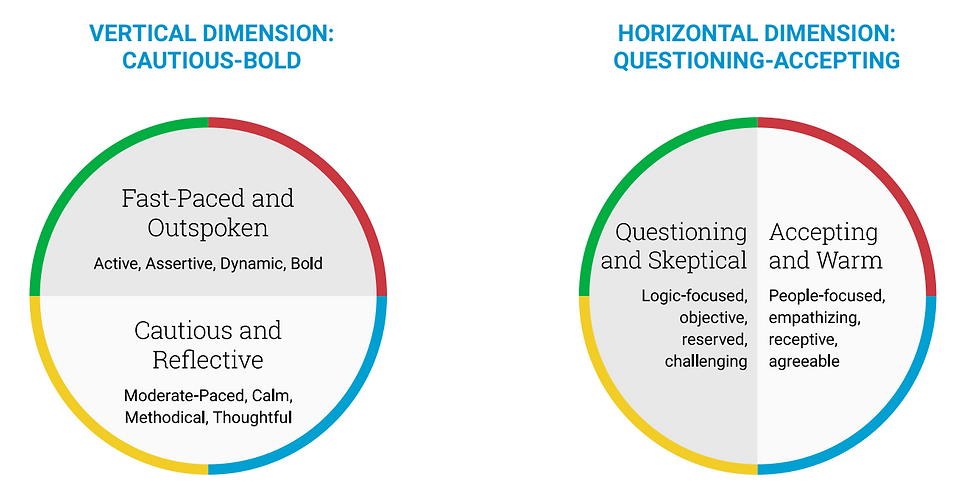
Wiley’s circumplex model reflects this behavioural continuum:

Your dot represents your home base. Your placement in the circle indicates your primary preferences, tendencies, and where your natural energy gravitates under standard conditions.
The shading illustrates your reach. You can call upon behaviours outside your home quadrant whenever a situation demands it, though doing so requires conscious effort and energy.
3. DiSC Measures Behavioural Tendencies, Not Ability or Character
DiSC profiles describe how you naturally prefer to approach problems, pace your work, and interact with colleagues. It explicitly does not measure:
Intelligence or cognitive ability
Professional competence or technical skill
Emotional maturity or character integrity
Psychological health or ethical capacity
Two people with the exact same Di style can have completely different job performance levels, moral standards, and industry skills. DiSC maps style, not competence.
Your work style is also influenced by other factors, such as life experiences, education, and maturity.
4. DiSC Explains Behaviour - It Never Excuses It
Behavioural self-awareness should never be weaponised as an excuse for poor conduct or rigid inflexibility.
A high-D style cannot dismiss harsh communication with: "I'm just a D, so I tell it like it is."
A high-C style cannot paralyze team progress by stating: "I'm a C, so I refuse to move forward until the data is 100% complete."
A high-S style cannot dodge necessary accountability by claiming conflict avoidance is just part of their profile.
Instead, the cornerstone principle demands personal responsibility: knowing your blind spots provides the exact roadmap for where you must exercise deliberate self-regulation.
5. Effective Interaction Requires Mindful Adaptation
Self-awareness is only the first half of emotional and social intelligence; the second half is situational agility. The ultimate objective of Everything DiSC is not getting others to accommodate your style, but learning how to read the behavioural needs of a situation and temporarily stretch your own approach.
When Interacting With: | Shift Your Natural Focus Toward: |
Dominance (D) | High-level outcomes, direct answers, concise options, and bottom-line impact. |
influence (i) | Open collaboration, big-picture possibilities, enthusiasm, and informal connection. |
Steadiness (S) | Methodical pacing, predictable timelines, genuine collaboration, and personal support. |
Conscientiousness (C) | Clear facts, logical reasoning, structured frameworks, and space to evaluate data. |
Everything DiSC Workplace® is DNV certified as an occupational test tool. It is EFPA compliant and to be used for development purposes.
The European Federation of Psychologists’ Association (EFPA) has developed a widely used

standard for reviewing psychological tests—which helps organisations, practitioners, and learners make informed decisions about the quality and utility of an assessment. And the DNV, an accredited body, has certified the compliance of our assessment to the EFPA’s standard.
Contact us to find out more about the full suite of Everything DiSC assessments and how they may be able to help you.

