


What Does a DiSC Assessment Profile Actually Tell You? (And What It Doesn't)

You've probably heard of DiSC. Maybe a colleague mentioned it, your HR team is considering rolling it out, or you've seen it referenced in a leadership development programme. But if you've ever wondered what a DiSC assessment profile actually reveals — and whether it's genuinely useful or just another tick-box exercise — this post is for you.
Let's cut through the noise and give you a straight answer.
The Short Version
A DiSC assessment profile tells you how you tend to behave at work — your priorities, your communication preferences, what energises you, what stresses you out, and how you're likely to come across to others. It gives you a language for understanding yourself and the people around you in a way that's practical and immediately applicable.
What it doesn't do is put you in a box, predict your future performance, or tell you whether you're suited to a particular job. More on that in a moment.
What a DiSC Assessment Profile Actually Measures
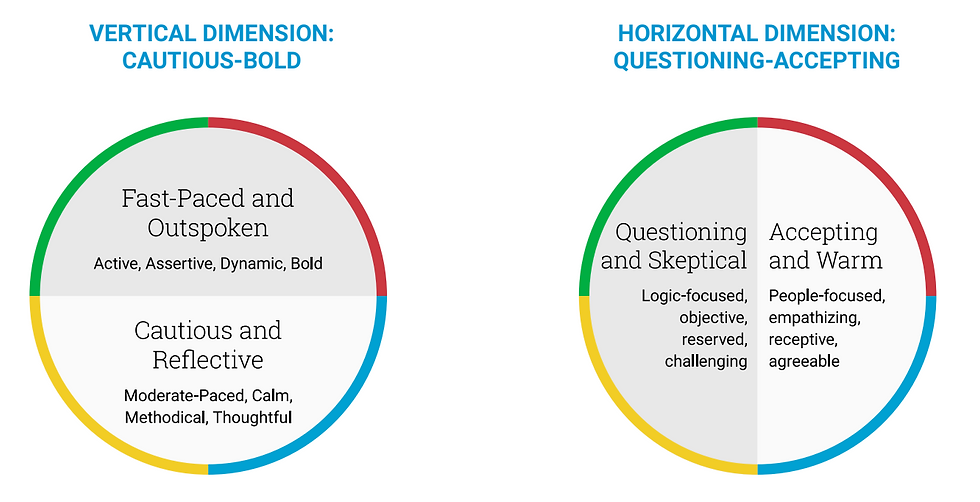
Everything DiSC profiles are built on a model that maps behaviour across two dimensions: whether you tend to be more fast-paced and outspoken or cautious and reflective, and whether you tend to be more questioning and sceptical or accepting and warm. These two axes create four broad quadrants — Dominance (D), Influence (i), Steadiness (S), and Conscientiousness (C) — and every person sits somewhere within that space, with their own unique blend of tendencies.

When you complete a DiSC assessment, you're answering a series of questions about how you naturally respond to situations at work. The resulting profile doesn't just tell you your primary style — it shows you exactly where you sit on the DiSC circle, how strong your tendencies are, and what that means in practical terms.
Here's what a good DiSC assessment profile will genuinely reveal:
1. Your Behavioural Priorities
Every DiSC style is driven by a core set of priorities — the things that feel most important and natural to you at work. A D-style person, for example, tends to prioritise results, challenge, and action. An S-style person prioritises stability, collaboration, and sincerity. Understanding your priorities — and recognising that your colleagues have different but equally valid ones — is often the most immediate and powerful insight from the profile.
It explains a lot of workplace friction that previously seemed like a personality clash. Often, it isn't personal at all. It's just two sets of priorities pulling in different directions.
2. How You Communicate — and How Others Experience You
This is where DiSC gets genuinely useful in day-to-day working life. Your profile will describe your natural communication style in honest, specific terms — how you prefer to give and receive information, what you value in conversations, and how you might come across to people who see the world differently.
A high-D style might communicate in a way that feels direct and decisive to them, but blunt or impatient to an S-style colleague. A high-i style might feel warm and engaging to themselves, but unfocused or over-the-top to a C-style. None of these perceptions are right or wrong — they're just what happens when different styles interact without awareness.
Your DiSC profile helps you see both sides of that equation.
3. What Motivates You and What Drains You
DiSC profiles are honest about the fact that different environments and tasks feel very different depending on your style. A D-style person will likely thrive in a fast-moving, results-driven environment but find slow-paced, process-heavy work genuinely draining. A C-style person will feel energised by deep analysis and attention to detail but find it exhausting to be constantly rushed or asked for quick decisions without data.
Knowing what fills your tank — and what empties it — isn't self-indulgent. It's useful intelligence for how you structure your work, where you need to build resilience, and how a manager can get the best from you.
4. Your Blind Spots and Potential Overextensions
Here's where DiSC gets refreshingly honest. Every style has strengths — and every strength, when overused or applied in the wrong context, can become a liability. The profile doesn't just celebrate your natural tendencies; it names the behaviours that can emerge under pressure or when your style is overextended.
A high-S style's gift for patience and steadiness can tip into conflict avoidance when things get difficult. A high-D's drive and decisiveness can become steamrolling if unchecked. A high-i's enthusiasm can drift into disorganisation. A high-C's rigour can slide into paralysis by analysis.
Knowing your blind spots isn't comfortable reading — but it's far more valuable than a profile that only tells you what you're good at.
5. How to Work More Effectively With Others
Perhaps the most practically useful section of any DiSC assessment profile is the guidance on adapting your style. Once you understand your own tendencies, you can start to recognise the styles of the people around you — and make small, deliberate adjustments that make a real difference to the quality of your working relationships.
This isn't about becoming someone you're not. It's about stretching slightly — slowing down for an S-style colleague who needs time to process, speeding up for a D-style manager who wants the headline first, adding more detail for a C-style client who needs evidence before they'll commit.
Small shifts, big results.
What a DiSC Profile Does NOT Tell You
This matters — because misunderstanding what DiSC is can lead to it being used badly. Here's what a DiSC assessment profile is explicitly not designed to measure:
Intelligence or capability. There is no DiSC style that is smarter, more capable, or more likely to succeed than another. DiSC measures behavioural preferences, not ability.
Whether someone is right for a job. Everything DiSC profiles are not — and should never be used as — a recruitment or selection tool. Using DiSC to screen candidates is a misuse of the instrument, and reputable DiSC providers will tell you exactly that.
A fixed identity. Your DiSC profile reflects your tendencies in a workplace context at a particular point in time. It is not a permanent label. People can and do shift over time, and your profile can look different depending on your environment and circumstances.
Mental health or emotional state. DiSC is a behavioural assessment, not a clinical or psychological instrument. It is not designed to assess mental health, neurodivergence, or emotional wellbeing.
A ranking or hierarchy. There is no best DiSC style. A team full of D-styles would be a chaotic sprint to nowhere. A team full of S-styles might never make a decision. The power of DiSC is in understanding and valuing the full range of styles — not elevating one above another.
Can I Game the Results?
It's a question that comes up surprisingly often — and it's worth addressing directly.
Yes, in theory you could try to answer in a way you think looks good. But here's why it's pointless: DiSC is not a test with right or wrong answers. There's no profile that's more desirable, no result that gets you a promotion, and no style that sounds more impressive than another. If you manipulate your responses, you simply end up with a profile that doesn't reflect how you actually behave — which means the insights, strategies, and guidance in the report won't work for you.
The most useful DiSC profiles come from people who answer honestly, including the bits they're not entirely proud of. That's where the real value is.
Is DiSC Scientifically Valid?
A fair and important question. Everything DiSC profiles are built on a research foundation that goes back decades, rooted in the original work of William Moulton Marston in the 1920s and refined significantly since. Wiley, who publishes Everything DiSC, invests heavily in ongoing reliability and validity research.
The assessments use an adaptive testing format — meaning the questions adjust based on your previous responses — which increases the accuracy of your profile compared to a standard fixed questionnaire. Independent research consistently shows strong reliability scores, meaning you'd get a very similar result if you took the assessment again.
That said, DiSC is not positioned as an academic psychometric in the same category as, for example, the Big Five personality model. It's designed for workplace application — to be immediately useful, accessible, and actionable. That's a deliberate design choice, and it's why DiSC works so well in training and development contexts where clinical precision matters less than practical insight.
What Happens After You Get Your Profile?
This is where a lot of organisations leave value on the table. A DiSC assessment profile is a starting point, not an endpoint. The people who get the most from DiSC are those who:
Take time to read their profile properly, including the sections that challenge them
Share their profile with colleagues and have an open conversation about styles
Use the Everything DiSC Catalyst platform to explore team dynamics and access tips in real time
Revisit their profile before difficult conversations or new challenges
Work with a facilitator to embed DiSC across a team or organisation
A profile read once and filed away is a missed opportunity. A profile that becomes part of how a team talks about working together is genuinely transformative.
The Bottom Line
A DiSC assessment profile won't tell you who you are as a person. It won't tell you what career to pursue or whether you're a good leader. What it will do — when used well — is give you a clear, honest picture of how you show up at work, why you click with some people more easily than others, and what small adjustments can make a meaningful difference to your relationships and your effectiveness.
That's not nothing. For most people, it's quite a lot.
Ready to Find Out What Your DiSC Profile Says About You?
Whether you're exploring DiSC for yourself or thinking about how to roll it out across your team or organisation, we're here to help. DISCGB is one of the UK's leading authorised partners for Everything DiSC — and we believe that understanding yourself better is one of the best investments you can make in your working life.
Not sure where to start? Get in touch — we're always happy to point you in the right direction.
Everything DiSC is published by John Wiley & Sons, Inc. DISCGB®️ is an award-winning UK Authorised Partner for Everything DiSC and The Five Behaviours.

